

re:befreiung


Visibility as refusal, and the question of which bodies are allowed to remain
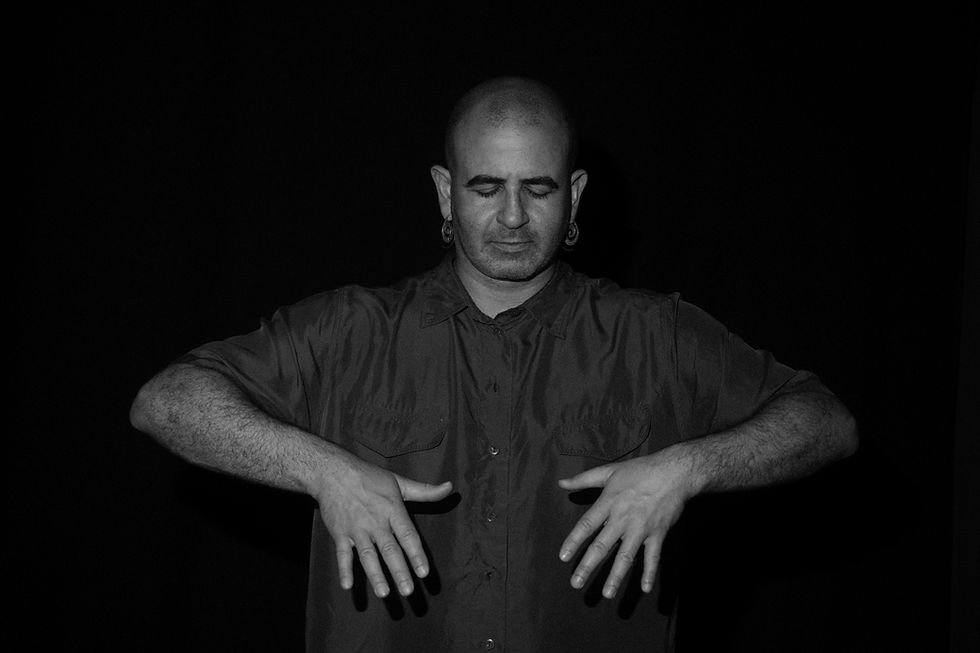
This text introduces my solo re:befreiung, presented in the opening program The Art of Protest at the 3 TAGE FREI – Festival der Freien Darstellenden Künste Stuttgart. The program brings together short performances responding to cultural funding cuts, political urgency, and the changing conditions of the independent arts scene in Baden-Württemberg. Within this context, I approach protest not as a theme, but as a lived practice.
I write to clarify how this work operates, speaking both to those who recognize these conditions and to those who participate in shaping them.
re:befreiung is the solo I perform within this context. The title connects two movements: liberation (Befreiung) and return. The “re:” refers to an earlier full-length solo through which I revisit and reactivate body memories. This work continues from that process, bringing these memories into the present.
I perform from within the conditions I address. Public discussions around cultural funding cuts often focus on loss—what is disappearing, what can no longer be sustained. Yet not every body is equally included in what is being defended. As Gayatri Chakravorty Spivak asks, “Can the subaltern speak?” More precisely: under which conditions is speech recognized as speech at all? I speak from a position that is not always fully legible within the structures that define legitimacy, visibility, and support within the independent arts field.
What is described as collective loss often reflects the perspective of those already stabilized within systems of support. As Donna Haraway reminds us, knowledge is always situated. I do not encounter precarity as a rupture. I work from within it as a continuous condition. This position is not outside the system; it is produced by the system itself, even when the system does not fully acknowledge it.
My practice moves between performance, research, and embodied knowledge. In this solo, I search for an aesthetic that reconnects me to histories and bodily understandings that existed before my direct encounter with dominant Global North frameworks. What emerges is unpolished, dense, and weighted. The work does not seek beautification or resolution. It sustains tension through contrasts: resistance and yielding, presence and withdrawal, control and disorientation.
Scores and Material Relations
The solo unfolds through a series of spatial, sonic, and bodily scores. These structures do not function as fixed choreography or narrative progression. They organize relations between movement, sound, rhythm, memory, friction, and perception. Through these shifting material conditions, tensions around visibility, instability, labor, and recognition emerge.

The performance begins in the audience.
I am already there. No announcement. No separation.
At first, the body appears recognizable.
Then it shifts. The rhythm does not fully align.
The gaze does not fully return.
A refusal becomes perceptible.
This refusal does not reject visibility.
It resists being stabilized.
Materiality of Sound
The work is structured through sound as material. The soundscape does not accompany the performance; it shapes perception and influences how the body is read in space.
The soundscape was created in collaboration with Pêdra Costa, a Brazilian artist whose trajectory has been marked by repeated refusals: refusals of access, legitimacy, and at times almost of existence within institutional frameworks.
In Costa’s work, refusal does not appear as absence or lack. It becomes force—a way of confronting imposed limits while opening other conditions for sensing, relating, and existing. Memory appears here as unstable, fragmented, and unresolved.
Fragments of Garota de Ipanema emerge throughout the space, but never fully arrive. The music is stretched, reversed, interrupted. At moments, a German version overlaps with the original—not as translation, but as interference. Recognition appears and dissolves at the same time.
Later, the soundscape shifts toward Rupestres Sonoros: O Canto dos Povos da Floresta, specifically Koi Txangaré by Mawaca. Another layer of memory enters the work, connected to Indigenous presence. Not as representation, but as acknowledgment of forms of existence that continue despite remaining structurally unrecognized. Presence alone does not guarantee legibility.
Throughout the solo, sound destabilizes orientation. It alters the perception of time, shifts access to memory, and affects how the body positions itself in space. The work creates a field in which recognition cannot fully settle.

The Body as Material
Within this shifting field, the body becomes material.
I remove layers of clothing. Not as revelation. As the removal of protections, projections, and expectations required to move through social space. The action shifts how presence is perceived and how the body relates to the sound-filled space around it.
Palm oil enters as a material agent acting on the body. Not as a symbol. Agent. It alters friction, temperature, and texture. It changes how the body moves, how it meets the floor, how it resists and yields. It can be read as sweat, as labor, as residue.
Presence intensifies as stability dissolves. Traces—visible and invisible—accumulate in space. The material does not illustrate meaning. It produces it. As the performance unfolds, interpretation begins to stabilize what is being seen. In a review for Stuttgarter Nachrichten, Andrea Kachelrieß wrote:
“Leonardo Rodrigues […] machte sich blank bis auf die Unterhose und schien in der Konfrontation mit dem eigenen Schweiß danach zu suchen, wie Arbeit und Armut einen Körper zeichnen.”(Kachelrieß, Stuttgarter Zeitung, 16 Apr. 2026)
The review connects the exposed body, sweat, labor, and poverty, reading the performance through the marks social conditions leave on the body. These elements are present within the work. From my perspective, however, no single interpretation can fully contain what the performance produces or allows to emerge.
re:befreiung does not resolve these tensions. It does not offer liberation as an outcome. I remain inside the negotiation—visible, but not contained; present, but not absorbed.
This text also remains unfinished. It does not stand outside the work, but continues moving with it. Like the performance itself, it ends without closure. What persists are tensions between visibility and containment, recognition and misrecognition, presence and absorption. The questions remain open: which bodies are recognized, which forms of precarity become visible, and who is allowed to remain present within structures that were not designed to fully hold them.
The following texts and authors echo questions, tensions, and sensibilities present in this work:
HARAWAY, Donna. Situated Knowledges: The Science Question in Feminism and the Privilege of Partial Perspective. Feminist Studies, v. 14, n. 3. Washington, D.C.: Feminist Studies, Inc., 1988.
HAN, Byung-Chul. Sociedade do Cansaço. Tradução de Enio Paulo Giachini. Petrópolis, RJ: Vozes, 2017. Título original: Müdigkeitsgesellschaft.
SAFATLE, Vladimir. Circuito dos Afetos: Corpos Políticos, Desamparo e o Fim do Indivíduo. Belo Horizonte: Autêntica Editora, 2015.
SPIVAK, Gayatri Chakravorty. Can the Subaltern Speak? In: NELSON, Cary; GROSSBERG, Lawrence (orgs.). Marxism and the Interpretation of Culture. Urbana and Chicago: University of Illinois Press, 1988. p. 271–313.
Press Reference
3 TAGE FREI – Festival der Freien Darstellenden Künste. “The Art of Protest.” Stuttgart, 2026. Available at: 3 TAGE FREI – The Art of Protest. Accessed on: 11 May 2026.
KACHELRIEẞ, Andrea. “Gala mit Protest: So startet das Festival für Tanz, Theater und Performance.” Stuttgarter Zeitung, Stuttgart, 16 Apr. 2026. Available at: Stuttgarter Zeitung article. Accessed on: 11 May 2026
If something here feels familiar, stay with it—and write from within that place in the comments below. I’d value hearing how it meets you.

Leonardo Rodrigues is a dance artist based in Mannheim, holding an MA in Contemporary Dance Education. He works as an autonomous educator, performer, researcher, and choreographer, using choreography to create conditions for exchange and to shift perception between people.

Comments